
Teams
In-House teams are responsible for everything that directly supports what happens inside the gathering itself. These teams help create clarity, engagement, and participation through worship, production, and communication.
The Worship Leader carries overall direction and health of the In-House ministry. In churches with a Production Leader, the Production Leader more directly oversees Sound, Lights, and Lyrics, while the Worship Leader continues to provide overall direction. The Band remains directly connected to the Worship Leader. This matches the reporting structure in the In-House Guide: the Pastor sets overall vision, the Worship Leader carries it through the service, and the Production Leader works under the Worship Leader's direction to oversee technical teams.
Healthy Sunday Gatherings are not built by one leader. They are built through intentional structure, clear leadership, and the faithful development of people over time.
The Worship Leader carries overall direction and health of the In-House ministry. In churches with a Production Leader, the Production Leader more directly oversees Sound, Lights, and Lyrics, while the Worship Leader continues to provide overall direction. The Band remains directly connected to the Worship Leader. This matches the reporting structure in the In-House Guide: the Pastor sets overall vision, the Worship Leader carries it through the service, and the Production Leader works under the Worship Leader's direction to oversee technical teams.
Healthy Sunday Gatherings are not built by one leader. They are built through intentional structure, clear leadership, and the faithful development of people over time.
In House Reporting Structure
Every In-House team should have a clear structure that creates ownership, develops people, and prepares the team to multiply.
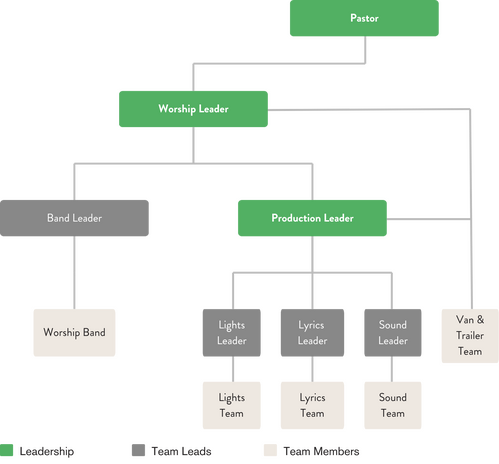
Leadership
Either the Pastor, Worship Leader, or Production Leader.
Team Lead
Carries responsibility for the health of their team - training, encouraging, and caring for the people serving alongside them.
Team Member
Serves faithfully with reliability, humility, and ownership, contributing to a healthy and dependable team.
Team Apprentice
The “next up” Team Lead - someone already demonstrating the character and reliability of a Team Lead who is being developed into greater responsibility.
Either the Pastor, Worship Leader, or Production Leader.
Team Lead
Carries responsibility for the health of their team - training, encouraging, and caring for the people serving alongside them.
Team Member
Serves faithfully with reliability, humility, and ownership, contributing to a healthy and dependable team.
Team Apprentice
The “next up” Team Lead - someone already demonstrating the character and reliability of a Team Lead who is being developed into greater responsibility.
In House Teams
WORSHIP BAND
Help the congregation sing clearly, confidently, and together.
The Worship Band's role is not performance but participation—helping the church see Jesus through singing and respond to Him with one voice. When the band plays and sings well, it makes it easier for the whole room to worship through song rather than simply watch.
Reports to: Worship Leader
Help the congregation sing clearly, confidently, and together.
The Worship Band's role is not performance but participation—helping the church see Jesus through singing and respond to Him with one voice. When the band plays and sings well, it makes it easier for the whole room to worship through song rather than simply watch.
Reports to: Worship Leader
LIGHTS
Create an environment that supports worship without drawing attention to itself.
The Lights Team helps create an environment where people can be present and engaged without unnecessary visual distraction. Lighting supports what is happening in the gathering rather than becoming the focus itself.
Reports to: Production Leader, or Worship Leader where there is no Production Leader.
Create an environment that supports worship without drawing attention to itself.
The Lights Team helps create an environment where people can be present and engaged without unnecessary visual distraction. Lighting supports what is happening in the gathering rather than becoming the focus itself.
Reports to: Production Leader, or Worship Leader where there is no Production Leader.
SOUND
Help the congregation hear every voice and instrument clearly.
The Sound Team exists so nothing technical stands between a person and the truth being sung, prayed, or preached. When sound is done well, the gathering feels clear, warm, and easy to engage with.
Reports to: Production Leader, or Worship Leader where there is no Production Leader.
Help the congregation hear every voice and instrument clearly.
The Sound Team exists so nothing technical stands between a person and the truth being sung, prayed, or preached. When sound is done well, the gathering feels clear, warm, and easy to engage with.
Reports to: Production Leader, or Worship Leader where there is no Production Leader.
LYRICS
Help every person engage with what is being sung, read, or preached.
The Lyrics Team visually supports the gathering so guests, regular attenders, and anyone who needs visual reinforcement can follow along and engage with the truth in front of them.
Reports to: Production Leader, or Worship Leader where there is no Production Leader.
Help every person engage with what is being sung, read, or preached.
The Lyrics Team visually supports the gathering so guests, regular attenders, and anyone who needs visual reinforcement can follow along and engage with the truth in front of them.
Reports to: Production Leader, or Worship Leader where there is no Production Leader.
Production Leader
The Production Leader works under the Worship Leader’s direction to oversee the technical teams that bring the gathering to life. They provide direct leadership to Sound, Lights, and Lyrics, helping develop Team Leads, maintain technical standards, and ensure those teams are prepared to serve the Sunday Gathering.
Where a church does not have a dedicated Production Leader, these responsibilities remain with the Worship Leader.
Where a church does not have a dedicated Production Leader, these responsibilities remain with the Worship Leader.
The Worship Leader & Team Development
As Worship Leader, your goal is not only to fill positions each Sunday. You and your Production Leader, if applicable, are responsible for building healthy teams and developing leaders who can carry increasing ownership.
That means continually working toward:
That means continually working toward:
- Healthy, dependable Team Members
- A capable Team Lead for each team
- Apprentices being intentionally developed
- Teams that can operate faithfully without depending on one person
Leading & Building Healthy Teams
Healthy Sunday Gatherings are not built by one leader. They are built through intentional structure, clear leadership, and the faithful development of people over time. The goal is not rapid growth for its own sake, but long-term health, clarity, and multiplication.
RECRUIT & ONBOARD
Healthy teams are consistently growing in number and depth. Worship Leaders should actively identify and invite new people to serve and create a clear onboarding experience so volunteers feel welcomed, not simply plugged into a position.
Every new In-House volunteer should receive their role's Team Member Reference Guide as the starting point for understanding their vision, responsibilities, and what winning looks like.
View In-House Team Reference Guide
Healthy teams are consistently growing in number and depth. Worship Leaders should actively identify and invite new people to serve and create a clear onboarding experience so volunteers feel welcomed, not simply plugged into a position.
Every new In-House volunteer should receive their role's Team Member Reference Guide as the starting point for understanding their vision, responsibilities, and what winning looks like.
View In-House Team Reference Guide
BUILD SUSTAINABLE TEAMS
Build depth on every team so that no single person's absence breaks a Sunday. Know your volunteers' capacity, honor the commitments they communicate, and whenever possible build rotations that allow people to serve faithfully without serving beyond their capacity.
A volunteer who serves joyfully once a month is often healthier and more sustainable than a volunteer serving every week out of obligation.
Build depth on every team so that no single person's absence breaks a Sunday. Know your volunteers' capacity, honor the commitments they communicate, and whenever possible build rotations that allow people to serve faithfully without serving beyond their capacity.
A volunteer who serves joyfully once a month is often healthier and more sustainable than a volunteer serving every week out of obligation.
CARE FOR YOUR PEOPLE
One of the most important responsibilities of a Worship Leader is shepherding your team. Volunteers are not resources to be managed or positions to be filled. They are people God has entrusted to your care.
Healthy teams are built on relationships, not schedules.
Encourage them. Affirm effort, growth, and faithfulness specifically. Celebrate wins, large and small.
Challenge them. Give clear and constructive feedback when needed. Uphold standards with grace rather than allowing problems to linger.
Connect them. Create opportunities for team members to build relationships beyond simply serving together on Sundays.
One of the most important responsibilities of a Worship Leader is shepherding your team. Volunteers are not resources to be managed or positions to be filled. They are people God has entrusted to your care.
Healthy teams are built on relationships, not schedules.
Encourage them. Affirm effort, growth, and faithfulness specifically. Celebrate wins, large and small.
Challenge them. Give clear and constructive feedback when needed. Uphold standards with grace rather than allowing problems to linger.
Connect them. Create opportunities for team members to build relationships beyond simply serving together on Sundays.